Not All Cafeteria Plans Are The Same

different

cafeteria plan is a mechanism that offers employees a choice between cash (i.e. their full salary as taxable income) or non-taxable qualified benefits (i.e. allows employees to pay with pre-tax dollars.)  All cafeteria plans are salary reduction plans based on Internal Revenue Code §125, however, there are many plan design variations and not all cafeteria plans are the same.

A Premium Only Plan (POP, also sometimes called a Premium Conversion Plan, PCP) is the simplest form of a cafeteria plan under IRS Code §125. It’s a “premium payment plan” and allows for employers to take certain employee paid premiums for insurance benefits pretax. (e.g. group health, dental, vision)

When you have a health and/or dependent care flexible spending account (FSA), that goes beyond the premium payment plan format because you are permitting employees to reduce their salaries before taxes to reimburse medical/childcare expenses.

In addition to the “rules” under IRS Code §125 found in a POP plan, FSAs are subject to special requirements contained in other IRS regulations.

Health FSAs are subject to requirements under Code §105 (self-insured medical reimbursement plans) Code §106 (the requirements for accident and health plans) and Code §125.

Dependent Care FSAs are subject to requirements under Code §129 (“Dependent care assistance programs”) and various special FSA requirements in Code §125 and IRS regulations. 

Therefore you need a more complex cafeteria plan document (often called a flexible spending plan) than a POP document to be in compliance when offering an FSA.  

The most complex form of a cafeteria plan, sometimes referred to as a “full flex” plan is where an employer provides employees “flex credits” to “spend” on qualified benefits. Depending on the plan design, the employee may be eligible to receive in cash, taxable compensation if the employee doesn’t “spend” all of his flex credits on benefits.

cafeteria

One requirement that every cafeteria plan must meet, is having a written plan document that includes all content specified in the IRS code. e.g. participation rules, election and election change procedures, manner of contributions, etc. 

While it is permissible to have separate cafeteria plan documents. i.e. a POP plan document for the insurance premiums and a separate cafeteria plan document for an FSA, for ease of administration most will include a POP component with in their flexible spending plan document.

According to the 2007 proposed cafeteria plan regulations (Treas. Reg. §1.125-1(c)(6))

(6) Failure to satisfy written plan requirements. If there is no written cafeteria plan, or if the written plan fails to satisfy any of the requirements in this paragraph (c) (including cross-referenced requirements), the plan is not a cafeteria plan and an employee’s election between taxable and nontaxable benefits results in gross income to the employee.

In simple terms, failure to have a written plan document employees would be treated as if they had a taxable benefit (e.g wages) even though they received a nontaxable benefit (e.g. health insurance).

The cafeteria plan document is what allows pretax salary reductions and contains the rules the IRS permits. It’s an important document to have and to understand.




REMINDER – PCORI Fees Due July 31, 2019

OLYMPUS DIGITAL CAMERA

Background:

The ACA imposes a Patient-Centered Outcomes Research Institute (PCORI) fee for all medical plans* ending on or after Oct. 1, 2012, and before Oct. 1, 2019.

If the plan is fully insured, the insurance carrier pays the fee on behalf of the plan sponsor (employer). If the plan is self-insured, the plan sponsor has the obligation to file Form 720 with the IRS by 7/31/2019.

NOTE: Health reimbursement arrangements (HRAs) are considered a self-insured health plan and are subject to PCORI fees. When an employer has an HRA with a fully insured medical plan, it’s considered two separate plans. The carrier pays the PCORI fee for the medical plan and the plan sponsor pays the fee for the HRA. When the employer has an HRA with a self-insured medical plan, they may be treated as one plan for purposes of calculating the PCORI fee.  

*PCORI Fees do not apply to

  • Plans providing HIPAA-excepted benefits e.g. stand-alone dental, vision, health FSAs (if other group health coverage is available and the employer contributes $500 or less)
  • Health Savings Accounts (HSAs)
  • Wellness programs, EAPs, disease management programs that do not provide significant benefits for medical care
  • Stop-loss insurance policies

Calculating the fee:

The amount of PCORI fees due for a self-insured medical plan is based upon the average number of covered lives (i.e. employees, dependents, COBRA participants, and covered retirees) under the self-insured medical plan and the applicable ERISA plan year (see table below).

The amount of PCORI fees due for an HRA is based upon the average number of covered employees (not belly buttons) under the HRA and the applicable plan or policy year.

Plan Year

Fee per average covered life

When fee must be paid

February 1, 2017 through January 31, 2018

$2.39

July 31, 2019

March 1, 2017, through February 28, 2018

$2.39

July 31, 2019

April 1, 2017 through March 31, 2018

$2.39

July 31, 2019

May 1, 2017 through April 30, 2018

$2.39

July 31, 2019

June 1, 2017 through May 31, 2018

$2.39

July 31, 2019

July 1, 2017 through June 30, 2018

$2.39

July 31, 2019

August 1, 2017 through July 31, 2018

$2.39

July 31, 2019

September 1, 2017 through August 31, 2018

$2.39

July 31, 2019

October 1, 2017 through September 30, 2018

$2.39

July 31, 2019

November 1, 2017 through October 31, 2018

$2.45

July 31, 2019

December 1, 2017 through November 30, 2018

$2.45

July 31, 2019

January 1, 2018 through December 31, 2018

$2.45

July 31, 2019

There are 3 acceptable methods for calculating the average number of covered lives:

  1. Actual Count Method – A plan sponsor may determine the average number of lives covered under a plan for a plan year by adding the totals of lives covered for each day of the play year and dividing that total by the total number of days in the plan year.
  2. Snapshot Method – A plan sponsor may determine the average number of lives covered under an applicable self-insured health plan for a plan year based on the total number of lives covered on one date (or more dates if an equal number of dates is used in each quarter) during the first, second or third month of each quarter, and dividing that total by the number of dates on which a count was made.
  3. Form 5500 Method – An eligible plan sponsor may determine the average number of lives covered under a plan for a plan year based on the number of participants reported on the Form 5500, Annual Return/Report of Employee Benefit Plan, or the Form 5500-SF, Short Form Annual Return/Report of Small Employee Benefit Plan.

Once the average number is calculated, Form 720 is what is used to report and pay to the IRS the amount of the PCORI fee due.

Some tips for completing Form 720 for PCORI fees:

An employer/plan sponsor needs to complete:

  • Company information and quarter ending “June 2019” (e.g. for 2018 plan year filing) – although the fee is paid annually, the tax period for the fee is the 2nd quarter of the year
  • Part II, IRS No. 133 Applicable self-insured health plans
    • Column (a), row (c) if plan ended before October 1, 2018, – enter “Avg. number of lives covered for self-insured health plans”

OR

    • Column (a) row (d) if plan ended on or after October 1, 2018 and before October 1, 2019 – enter “Avg. number of lives covered for self-insured health plans”

AND

    • Column (c) – enter total Fee (lives x $)
  • Part II, Line 2 – enter Total Tax (from calculation in IRS No. 133)
  • Part III, Line 3 – enter Total Tax (from Part II, Line 2)
  • Part III, Line 10 – enter Balance Due (from Part III, Line 3)
  • Signature section
  • Payment voucher with “2nd Quarter” checked,
    • Send the form, payment voucher, and check to:
      Department of the Treasury
      Internal Revenue Service
      Cincinnati, OH 45999-0009

July 31, 2020 will be the final year for paying PCORI fees under the current ACA Risk & Market Stabilization Programs for plan years ending before October 1, 2019.

e.g.

Plan Year Fee per average covered life When fee must be paid
February 1, 2018 through January 31, 2019 $2.45 July 31, 2020
March 1, 2018, through February 28, 2019 $2.45 July 31, 2020
April 1, 2018 through March 31, 2019 $2.45 July 31, 2020
May 1, 2018 through April 30, 2019 $2.45 July 31, 2020
June 1, 2018 through May 31, 2019 $2.45 July 31, 2020
July 1, 2018 through June 30, 2019 $2.45 July 31, 2020
August 1, 2018 through July 31, 2019 $2.45 July 31, 2020
September 1, 2018 through August 31, 2019 $2.45 July 31, 2020
October 1, 2018 through September 30, 2019 $2.45 July 31, 2020
November 1, 2018 and all following renewals Fee expires for plans ending before 10/1/2019. No further payments required.

Intern is not synonymous with seasonal employee

summer

It’s important for employers to classify their employees correctly – especially Applicable Large Employers (ALEs) who must comply with the “pay or play” employer mandate.

The ACA does not require an ALE to offer coverage to a “seasonal” employee, however it’s imperative to understand how the ACA defines seasonal, to avoid exposure to penalties.

Per Treas. Reg. 54.4980H-1(a)(38) the term seasonal employee means “an employee who is hired into a position for which the customary annual employment is six months or less”. 

Customary” means “that by the nature of the position an employee in this position typically works for a period of six months or less, and that period should begin each calendar year in approximately the same part of the year, such as summer or winter”

Examples:

  • Ski resort instructor hired each year from November until March
  •  A cattle ranch who hires extra ranch hands during foaling season, April – Sept.

However, there are no special pay or play rules for internships. Therefore, when deciding how to classify an “intern”, a key part of the seasonal definition that needs to be considered is “approximately the same part of the year”.

An employer who only hires temporary, full-time positions (i.e. interns) at a specific time of the year (e.g. summer) and they work for less than six months, it may be possible to classify them as seasonal. However an employer who hires interns at various times of the year, those interns may not satisfy the seasonal definition.

Why does it matter?

An employer mislabeling their interns as seasonal and not offering coverage for any month in which they were required to be treated as full time, may face ACA noncompliance penalties. i.e.  If the interns are less than 5% of the employee population, $312.50 per month. If they make up more than 5%, there is exposure to the §4980Ha penalty, 1/12($2,500) per month x total number of full-time employees minus 30.

Intern is not synonymous with seasonal employee but it is possible under the right circumstances for an intern to be seasonal.


Healthcare FSAs Uniform Coverage Rule – an Employer’s Risk

Risk

Under the uniform coverage rule, the full amount an employee elects under a health flexible spending account (health FSA), must be available from the first day of the plan year and must remain available at all times during the coverage period. It requires employers to reimburse expenses up to the full employee health FSA election amount, even if such reimbursements exceed the employee’s year-to-date contributions.

This means an employee can potentially terminate employment having been reimbursed under the health FSA for more than they contributed up to the time of their termination.

EXAMPLES:

  • Tom enrolls for the first time in his employer’s health FSA, electing the full 2019 IRS limit of $2,700 for their April 1, 2019 – March 31, 2020 plan year.  Tom resigns effective April 30, 2019. By the end of that month, he has paid $225 into his health FSA account via salary reductions. On his last day of work (April 30, 2019), Tom submits a claim to be reimbursed for $1,900 of medical expenses that he incurred for his sons recent surgery on April 22, 2019. Tom’s employer must reimburse the full $1,900, even though he only contributed $225 before his employment ended (assuming the expenses are adequately substantiated) and the employer may not recoup the difference. 
  • Mary enrolls in her employer’s calendar year (1/1- 12/31) health FSA, electing the full 2019 IRS limit of $2,700. Mary is paid semimonthly. Throughout the year, Mary submits medical expenses totaling the full amount of $2,700.  Mary resigns effective 11/15, leaving her health FSA overspent (i.e. more was reimbursed than contributed via payroll deduction) by $337.50. Mary’s employer may not withdraw the balance from her last paycheck. 

The uniform coverage rule is part of the risk an employer takes when establishing a health FSA.  The point of the rule is that the employer must bear the risk of loss (i.e. operate like an insurance plan, rather than a mere reimbursement account) in order for the arrangement to qualify as a health FSA.

Although the uniform coverage rule is a risk, in my experience, most employers with health FSAs when looking at the plan year as a whole, do not pay out more in claim reimbursements than they receive in employee contributions. In fact, because of the risk of the  ‘use it or lose it rule’ for employees which generally requires employees forfeit to the employer any unused amounts left in their accounts at the end of the plan year, most employers total contributions exceed total reimbursements for the year.


Health savings account (HSA) eligibility is often misunderstood

question-mark-1722862_960_720

IRS Publication 969 outlines the rules for one to be eligible for an HSA. To be eligible one must:

  1. Be covered under a high deductible health plan (HDHP), on the first day of the month.
  2. Have no other health coverage except what is permitted under “Other health coverage” (also defined in the publication)
  3. Not be enrolled in Medicare.
  4. Not be claimed as a dependent on someone else’s tax return.

Of these four eligibility rules, there is often confusion around item #2. Many do not connect “other health coverage” with health FSAs/HRAs.

Employees enrolling in their employer’s general purpose (i.e. can be used for medical expenses) health FSA or HRA or an employee’s spouse being enrolled in their employer’s health FSA, generally disqualifies an employee from making or receiving HSA contributions for the entire plan year.

Likewise, if there are funds left in an employee’s health FSA at the end of the FSA plan year and there is a:

  • grace period (i.e. up to an additional 2 ½ month period after the FSA plan year ends when expenses may be incurred) an employee is not eligible to make or receive HSA contributions until the first of the month after the grace period is over.
  • carryover provision (i.e. permitting up to $500 of the unspent FSA balance to be used in the next plan year) an employee will be ineligible to make or receive HSA contributions for the entire plan year.

There are ways for a health FSA or HRA to be designed (e.g. post-deductible or limited-purpose) so it’s compatible with an HSA and there are also ways for employers to ensure employees don’t lose HSA eligibility for the following year (e.g. if FSA has a carryover provision and an employee elects an HDHP, the balance automatically transfers into a limited purpose FSA), so it’s important to work with your benefits consultant and FSA administrator to ensure employer-provided benefits don’t become “gotcha’s” for your employees.

COBRA extensions & Medicare

lightbulb

As mentioned in a previous post Common Medicare entitlement (enrollment) COBRA mistake…are you making it too?, Medicare entitlement (i.e. eligible & enrolled) is only a COBRA qualifying event (QE) if it causes an employee to lose group health coverage (i.e. under 20 lives, or retiree plan). So due to Medicare Secondary Payer (MSP) rules, Medicare entitlement is not a COBRA QE for the employee, nor is it a QE for the spouse (or dependent) who loses the employee’s group health coverage when the employee voluntarily drops the employer’s plan and enrolls in Medicare.

However, Medicare entitlement does not have to cause the loss of coverage for the spouse or dependents when it comes to being eligible for a COBRA extension. There is a special rule, which extends the maximum COBRA coverage period for spouses and children, (but not for employees) to 36 months of COBRA coverage vs. the typical 18 months when the qualifying event (e.g. retirement) occurs after the employee becomes entitled to Medicare but remained on their employer’s group plan.

In those cases, the spouse and dependents are entitled to the longer of (i) 18 months from the date of the qualifying event (retirement); or (ii) 36 months from the date of Medicare entitlement.

For example: Jack works for Up the Hill, Inc. He and his wife Jill are covered by a group health plan which is subject to COBRA. Jack becomes entitled (enrolled) to Medicare on May 1st. Jack and Jill also remain covered under the group health plan offered by Up the Hill, Inc. On January 1st (8 months later), Jack retires and therefore Jack and Jill both experience a qualifying event (termination of employment).

Jill would be eligible for 28 months of COBRA coverage. (36 months minus 8 months)

On the other hand, if Jack waits longer than 18 months to retire after he enrolls in Medicare, Jill will just get the regular 18 months of COBRA.

Either way, Jack is only entitled to 18 months of COBRA upon retirement.

COBRA regulations appear simple on the surface but the rules are rather complex.  Best practice is for employers to work with a competent third party COBRA administrator who can help them comply with the challenging requirements.

Unsubstantiated FSA card transactions

credit card

Code §§105 and 125 require the substantiation (e.g., a receipt or bill) of all medical expenses paid or reimbursed from a health flexible spending account (FSA). Generally, substantiation occurs prior to funds being released, however, many FSAs allow access to the funds using a debit/credit card when the service is provided or item purchased.

When the card is swiped, IRS guidance allows certain purchases to be auto-adjudicated (i.e. they do not require further substantiation) while other purchases are allowed to be to be paid at the time of the swipe but require additional information to be submitted to the FSA administrator after-the-fact. This additional information is reviewed and then a determination is made whether the expense was/wasn’t eligible under the plan.

If employees use health FSA funds and the expenses weren’t verified, (i.e. additional information for proper substantiation is not subsequently provided) of if they used the money for an expense that was determined not to be eligible, then certain correction procedures need to be followed to recoup the money for the claims improperly paid. The employer’s FSA plan documents should contain substantiation rules and correction methods.

However, in general per Proposed Treasury Reg. §1.125-6(d)(7) the employer must ask that the employee repay the plan.  If the employee fails to repay the plan, the employer must withhold the amount from the employee’s pay, to the extent allowed by law.  If neither of the aforementioned methods results in full repayment, the employer must apply an offset against properly substantiated claims incurred during the same plan year.  As a last resort and after exhausting other required collection procedures, an employer may include unsubstantiated FSA expenses in an employee’s gross income.  The amount would be included in the year in which it was forgiven (e.g., included in the W-2 for 2019 if an amount owed from 2018 was forgiven in 2019).

However, imputed income should be the exception rather than the rule, and used as a last resort. Per, Chief Counsel Advice 201413006 (Feb. 12, 2014) “Repeated inclusion in income of improper payments suggests that proper substantiation procedures are not in place or that the payments may be a method of cashing out unused FSA amounts.”

Although employers generally are using a TPA for FSA administration and perhaps the contract/agreement with the TPA outlines whose role it is regarding claims substantiation, at the end of the day, it is the employer’s responsibility to ensure the plan is administered correctly.  {The term “administrator” in a cafeteria plan document equals employer. It is not the same as Third Party Administrator. (i.e. an employer can’t pass off the liability to a TPA. If the TPA doesn’t perform, it’s still on the employer.)}

If a plan fails to comply with the substantiation requirements, it’s an “operational failure” and the entire plan will be disqualified, with employees’ elections between taxable and nontaxable benefits resulting in gross income to the employees.

FSA – Grace Period vs. Run Out Period

run out grace 1

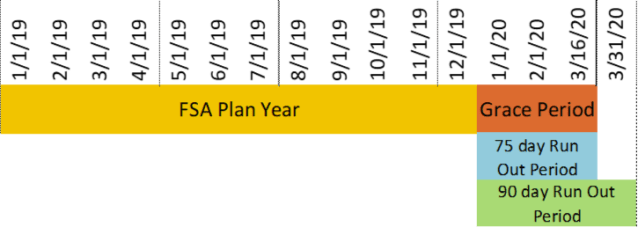
FSA plan year = 12 month period expenses may be incurred

Grace period = up to an additional 2 ½ month period after the FSA plan year ends when expenses may be incurred, as determined by the plan administrator (i.e. employer)

Run-Out period = time frame after the plan year and/or grace period has ended to submit claims for expenses incurred during the plan year and/or grace period (depending on plan design & determined by plan administrator)

Some plans are set up to have two run-out periods, one that starts at the end of the FSA plan year and a 2nd one that starts at the end of the grace period.

run out grace 2

Not all TPAs systems will accommodate this, rather they only allow the run-out period to start at the end of the FSA plan year. Therefore, if you want employees to have time to submit claims after the grace period ends for expenses incurred during the grace period, you must ensure the run-out period time frame is longer than the grace period.

run out grace 3

Staffing firms are unique

unique apple-1594742_960_720The legal issues that arise for staffing firms (e.g. employment agencies, employee leasing organizations) or employers using staffing firms come down to answering these questions:

  1. Are the workers employees of the temp agency, the recipient organization (e.g. the employer they perform services for), or both?
  2. If they are employees, are they common-law employees, Code §414(n) leased employees, or both (and with respect to which entity)?

The answers depend upon facts and circumstances, and the conclusions are fact specific. The implications (e.g. employment taxes, eligibility to participate in group health plans) depend on the conclusions. For example, most health insurance contracts limit coverage to common-law employees of the employer. If a staffing firm’s health coverage is offered pursuant to a group insurance contract, then an extension of coverage to individuals who are not common-law employees may violate the contract. Stop-loss insurance contracts offered pursuant to a self-insured or partially self-insured health coverage arrangement typically contain similar eligibility limitations. Moreover, if the staffing firm’s group health plan is self-insured, the extension of health benefit coverage by the staffing firm to individuals who are not common-law employees could cause the staffing firm’s group health plan to be a MEWA under ERISA.

The Employer Shared Responsibility Provision must also be taken into consideration when using temp workers and who is responsible for making an offer of affordable coverage.

Whenever two or more businesses (such as a staffing agency and a recipient organization) exercise control over an employee’s work or working conditions, the businesses may be considered to be joint employers. So for example determining whom is responsible for FMLA may come up too.

In general, the use of staffing agencies raise special issues under ERISA, COBRA, HIPAA, EEOC and Other Group Health Plan Mandates therefore it’s always best to consult with qualified counsel.

Common Medicare entitlement (enrollment) COBRA mistake…are you making it too?


question-mark-1872665_960_720

Medicare entitlement (i.e. eligible & enrolled) is only a COBRA qualifying event (QE) if it causes an employee to lose group health coverage (i.e. under 20 lives, or retiree plan). Otherwise, due to Medicare Secondary Payer (MSP) rules, Medicare entitlement is not a COBRA QE for the employee.

Likewise if the employee voluntarily drops group coverage because they enroll on Medicare and as a result, the dependents (e.g. spouse) then lose employer coverage, this also is not a COBRA QE for the dependents. Medicare entitlement didn’t “cause” the loss of eligibility, rather the employee deciding to drop the employer’s group coverage did.

In other words, when an employee drops their employer’s plan because they enrolled in Medicare, the spouse should not be offered COBRA coverage, but it happens all the time.

Although this is something often incorrectly administered, it is a potential MSP issue because it could be viewed as an incentive for the employee to drop the group plan in favor of Medicare (knowing the spouse will have continuation coverage).

Employees who are turning 65 may also need additional education, to allow them to make an informed decision when deciding whether to enroll on Medicare in lieu of their employer’s plan.